How to keep in touch

By e-mail: perrier.raymond@gmail.com
By skype: raymondperrier (though not yet working at home)
By text (if in the UK): 0775 813 5997 (cheaper than texting to SA)
By landline: + 27 11 726 2307 (after 6pm GMT)
By post: PO Box 31087, Braamfontein 2017, South Africa
By prayer.....

Monday, 30 August 2010

They think it’s all over!

And in a real sense it is.  It is now 7 weeks since the end of the World Cup and the place is more or less back to normal.  But I am conscious that I did not give you (gentle reader) any live commentary at the time so, before I move on, let me return for one more blog to those extraordinary 30 days in which South Africa was at the centre of the universe. 

I don’t know how much hype there was about the World Cup wherever you are in the world, but here it was to the power of 2 – or probably the power of 32 since we seemed to add to our own excitement the enthusiasm of all the other countries participating. 

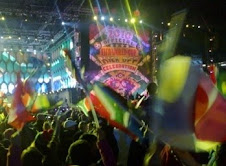
One of the clearest indicators of this was the way in which every part of the city was festooned with flags.  One of the catchiest of the football songs (inevitably hijacked by Coca-Cola) was ‘Wavin’ flag’ from the Somali singer K’naan and this whole nation of 40 million people took him at his word.  And there were flags not just on buildings, but on faces, on every lamp-post, hanging from car windows, shop windows and office windows, and even on car wing mirrors. 

One of the reasons for this was a (sub-)conscious reaction to the trademark fascism of FIFA.  The self-declared guardians of football (carrying out a strategy that Interbrand devised for them 10 years ago) were determined to own everything connected with the championship.  No teddy bear could be bought, no shirt worn, no beer drunk, and no hot dog scoffed unless it was a FIFA authorised product with appropriate logo and payment of royalty.  This resulted in the sort of madness that meant that top executives being hosted to extravagant hospitality in corporate boxes in the grounds were forced to drink ‘Bud’ if they wanted a beer.  And we lesser mortals, looking to eat in stadiums, could not enjoy the freshly braaied wors sausages for which South Africa is famous (and which are usually supplied at grounds by independent entrepreneurial traders).  Instead our only option was to queue for ages to buy a hideous micro-waved ‘wiener’ manufactured by an official partner.  “For the good of the game” is FIFA’s claim.  Well let’s hope so since it was certainly not for the good of the fan, the local entrepreneur or the reputation of FIFA. 

But the flags were the great subterfuge.  Because flags and national colours cannot be owned, even by Sepp Blatter.  So it seemed that every enterprising young chancer in Jo’burg was standing at a set of traffic lights selling flags; in all colours and in all sizes.  As a point of principle I kept buying them just to prove that there was a commercial dimension to this venture that was not dependent on trademark deals stitched up by multinationals. 

I wonder if there was also something more philosophical underneath.  The new South African flag was hard fought for.  The old won celebrated layers of colonisation.  The new one is a clear rupture with the past.  But the film ‘Invictus’ shows that even a year after democracy there were still old South African Union flags being used.  There is immense pride in the South African flag – the Durban stadium was designed to imitate it, the national broadcaster is still flying a giant one on its Stalinist building – and it can now truly be said to be a symbol that unites the nation.  And South Africans’ pride in their own flag extends beyond to all flags, depending on who was playing on each day.  So when South Africa exited the tournament, more valiantly than anyone had expected, we could easily shift our pride to other people’s flags.  (Perhaps this is most mysterious for Brits who have a conflicted relationship with the Union Flag and don’t even play under those colours in international football).

People of all colours showing pride in South Africa – the team and the flag – was something that everyone was hoping for from the World Cup.  And it was evident everywhere.  When Bafana Bafana were playing, the whole country ground to a halt and no one complained that work was abandoned.  Cheering the national team after all was national work.  But then when Ghana became the only African team to survive into the second round, allegiance switched wholesale from Bafana Bafana to the renamed ‘Ba-Ghana Ba-Ghana’.  One could hardly imagine England fans shifting their allegiance to Greece or Americans to Costa Rica just because they happen to be at the other end of the same continent. 

South Africa’s relationship with the rest of the Continent is highly complex.  Sometimes they treat it entirely as something alien and distant; people from Jo’burg ‘go to Africa’ in the same way that Londoners ‘travel to Europe’.  But then at other times, South Africans appropriate the whole Continent – by for example using a map of the whole of Africa as the logo of purely South African companies.  Thus, this support of Ghana was more surprising than you might have imagined, even among black South Africans who are not always hugely welcoming of their neighbours.  But the real surprise was when I saw a middle-aged white man at a game mixing his Springbok scarf (a staunch signifier of Afrikaans pride) with a yellow, green and red hat (a clear sign of African pride); we have witnessed a profound shift. 

Of course, I did not spend the entire 30 days reflecting on such philosophical questions.  I also managed to attend 6 live games, watch dozens more in bars all round the city (I don’t have a TV so I had to go out!), skive off work several times so I would not miss kick-off times, stand just below Desmond Tutu when he appeared at the pre-World Cup music spectacular, sit in hotel lounges with Nike aficionados discussing tactical variations, dance myself silly with Dutch-Spanish-Mexican supporters at 2am on weekday nights, and even blow a vuvuzela occasionally.  It was Christmas and New Year – only longer, more drunken, more disorienting and more fun. 

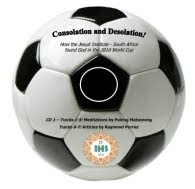
And the Jesuit Institute also found a way to leap on the bandwagon (without so far being sued by the trademark police).  The Jesuit claim is to be able to find God in all things so we decided to see how we could find ‘the hand of God’ in the World Cup, off as well as on the pitch.  And the response to this challenge – reflections, articles, pictures and lectures – is reproduced on a double CD, a copy of which is even being delivered via the Papal Nuncio to the Benedict XVI.  (Copies available from me for £6/ $10). 

And if you were expecting comment from me on England’s performance, I shall refer you to Wittgenstein’s dictum: “whereof we cannot speak, thereof we had best keep silent.”

Thursday, 10 June 2010

Ayoba!

Some of you might be surprised that I can even spell football, let alone write about it.  But in fact – who says miracles don’t happen? – I am as excited as everyone else in South Africa about the World Cup.  I have even given the staff a holiday so we can all go and watch the opening match.

Win, lose or draw on Friday, South Africans really feel that we have won already.  For the first time the African Continent will be hosting the world’s largest sports event.  And you cannot escape it.  As the national broadcaster keeps reminding us: “Feel it!  It is here!”

There is huge pride that South Africa was granted ‘2010’ (as it is universally called here).  Of course, part of that is a pragmatic hope that it will bring tourists, foreign investment and hard cash.  But there is something much deeper.  It is South Africa’s coming-of-age.  Yes, they did hold the Cricket World Cup in 2003; and both hosted and won the Rugby World Cup in 1995 (as you may have been reminded in the inspiring film ‘Invictus’).  But around here, these are minority sports played and watched by ‘whiteys’, ‘coloureds’ and ‘Indians’.  The people’s game is football.  And it is followed with a passion. 

So the Football World Cup legitimises the passions of the ordinary black South African.   And this only 16 years since the first real elections.  South Africa is a teenage country.  And like most adolescents, although we claim not to care what the world thinks about us, we care desperately. We want to be taken seriously.  We want to be among the grown-ups.  We want to play with the big boys!

And the boys – Messi, Ronaldo, Eto’o, Rooney, Drogba – and the statistics don’t get bigger than in football.  32 countries taking part (out of the 204 that attempted to qualify); 64 matches played over 30 days in 10 fabulous stadia and watched live by over 3 million paying spectators (and I am 5 of them!).  And then the real prize: a claimed cumulative TV audience of 25 billion people over the month.  Can that really be right? – the hyperbole makes it hard to separate fact from fantasy.

But one key fact is that South Africa will be welcoming the world, and will be wanting to show its best face.  Some parts of that face are most impressive.  All the stadia were finished well ahead of time (even if over budget).  Some, such as the gold-coloured Greenpoint Stadium overlooking the bay in Cape Town, or the elegant white swan of Moses Mabhida in Durban, are breathtaking.  The new rapid transport systems in some cities will be (more or less) ready in time.  Even the elaborate on-line ticket system, after some initial problems, is working well: though I confess that it took me 5 attempts and I ended up with a ticket to see Argentina vs Korea!

Of course, it is not all plain sailing.  There are still concerns that some visitors are going to be mugged as they travel round: either physically by our world-class criminals, or more subtly by our quick-buck entrepreneurs.  And the stunning new monorail linking the airport with Johannesburg and Pretoria will be ready only 2 years after the football fans have gone home.  (Though before you get too smug about that bear in mind that London’s equivalent, Cross-rail, will be ready only 3 years after the Olympics.) 

The attempt by every organisation in town to get in on the bandwagon is shameful. 
An SA flag made out of different coloured Le Creuset pots is the lamest I have seen to date.  But I am pleased to say that even the Jesuit Institute has found a small space on the bandwagon.  I hope some of you will enjoy our series of short downloadable football meditations: www.pray-as-you-go.org/Worldcup2010.htm

But there is a darker side to all this jubilation.  South Africa has, of course, been welcoming the world for a number of years – Brits and even Americans have discovered the unparalleled beauty of South Africa’s game reserves, winelands and beaches.  But since the end of Apartheid, South Africa has also seen a steady flow of migrants from Zimbabwe, Nigeria, Congo and other parts of Africa who do not go home after their 2 week holiday.  And these visitors are a lot less welcome.

The South African economy is one of the most buoyant in Africa and so has attracted Africans whose countries are less stable, less prosperous or less well-resourced.  But there are still limited jobs here and many people, having suffered in the past, are now discovering that the end of Apartheid does no mean automatic prosperity for all.  Shamefully, although there is now a prosperous black middle class, overall the levels of inequality in South Africa have actually increased since 1994 and are now among the worst in the world. 

It is unfortunate, but not surprising, that many who once suffered oppression because of their race have not been slow to oppress others because of their nationality.  The sci-fi film ‘District 9’ was not, as many people thought, about racism in Apartheid South Africa – it was about xenophobia in the New South Africa. 

In the face of this, as we go into a Southern Winter, I hope that the Church can provide both light and warmth.  The light of raising awareness of the plight of different peoples and reminding us of our common humanity – all born in the image and likeness of God.  And the warmth of a welcome when so many others have turned a cold shoulder.  The Jesuit parish here in the centre of Johannesburg is home to many different African communities who feel welcome here where they know they will be treated with respect.  We can pride ourselves that ‘Catholic’ really does mean ‘universal’. 

At Holy Trinity it is not just a warm welcome and a smile that are offered – important though those are – but some practical help as well.  The parish provides a hot meal every morning to hundreds of street homeless.  And once a week, working with students from the university next door, there is a drop-in clinic for those who have no access to medicine.  The clinic has been so successful that last month it moved from the car park into newly created consultation rooms below the church.  And with that comes the opportunity to dispense anti-retroviral treatments to people with HIV. 

While you are watching the World Cup you are bound to get a glimpse of the ‘vuvuzela’: almost South Africa's national musical instrument. A big plastic trumpet, brightly coloured, and blown with gusto by all fans at every football match in the country. The sound it makes is something between the bellow of a constipated elephant and the buzzing of a giant swarm of baritone bees.

As you listen to it, let me give you some images of these trumpets.  They could be warding off foreigners – warning them not to come close.  Or they could be joyful instruments of welcome to bring a smile to the face of a stranger.  We might, with some justification, use them to trumpet the good work that the Church does here and in other parts of Africa.  But I hope we will, like the Israelites at Jericho, see them as trumpets of the power for good with which we can bring down the walls of poverty and oppression and discrimination.  Now that would be a world cup worth winning!

Thursday, 27 May 2010

Education, ejucayshun, eduKshn!

Recently, a new young thrusting Oxonian prime minister has been offering the British public negotiation, negotiation, negotiation.  But 13 years ago the dawn rose over a previous young thrusting Oxonian prime minister and the solution he offered was the three-fold mantra of education, education, education. 

It is a truism that education is key to unlocking potential and 3 years at Oxford has proven useful even for those of us who don’t end up as Prime Minister.  But this month my thoughts have been far from those dreaming spires and, instead, closer to the coal face of education as it is found in South Africa. 

For those looking for an education bargain, the independent colleges of Johannesburg – or better still the boarding schools nestling in the hills of KwaZulu Natal – provide fantastic value.  First class facilities, classes of 20 students, highly qualified staff, committed and organised parents, and excellent co-curricula opportunities – all for a fifth of the price of the equivalent in the UK or US.  And to assuage the consciences of those embarrassed by placing their children in a white ghetto, there are just enough non-white children to make the school photos look politically correct – though not so many that the ‘character’ of the school is lost.  (In fact, I was told in all seriousness by one local parent that she had moved her daughter from a co-ed primary school to an all-girls secondary.  While she wanted her daughter to have friends who were ‘African’ girls, she did not want her falling in love with some African boy.  The final laugh would be if her daughter turned out to be lesbian!). 

Unlike in other countries, the Jesuits do not run any schools here – their only South African school closed several years ago – but a number of the well-known private schools are Catholic foundations and try, some more successfully than others, to maintain a Catholic ethos.  They are, of course, caught between the rock of good intentions and the hard place of competing in the market.  Values are very important, say the parents, but the rugby fields and the exam results are what we are really paying for. 

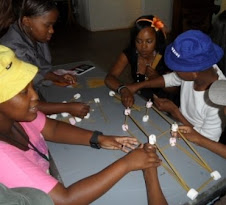
I have not yet had much to do with this part of the education world.  But curiously an executive development programme that the Jesuit Institute was offering has turned out to be especially attractive to the senior management of some of the private schools.  The course is designed to help people align their business organisations with their deepest values.  In a symmetrical way, these schools are trying to align their values-based organisations with their business needs. 

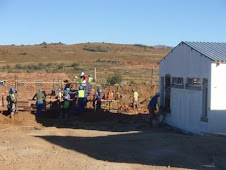
Meantime, the part of the South African education world with which I have had most contact recently has been the very opposite end of the scale: rural primary schools with classes of 50 or 60; often under-qualified teachers, un-engaged parents, dirt fields rather than astro-turf, and a constant struggle to scrape together enough budget to repair the windows, pay the teachers, buy some equipment.  According to UN Development statistics, South Africa spends one of the highest % of GDP in the world on education, and yet some of these schools are only a few grades above what I witnessed in the refugee camps in Uganda.  

At the invitation of the Catholic Institute of Education, I have been visiting and working with the principals of rural Catholic primary schools.  Often these were mission schools, set up by a religious congregation decades ago, and now handed over to the community.  They are termed ‘public schools on private property’ which means they get most of the benefits (and the bureaucracy) of being a state-funded school while retaining some of their distinctive character.  They cater to the whole of the population of the village or the farm where they are which means that they rarely have more than 20%-30% Catholic students.  And most of their children would come from families reliant on agricultural labour or ad hoc tourism.  They thus struggle to get out of a vicious cycle of poverty, low aspirations, low skills and more poverty.  With an added dose of alcoholism among those whose labours provide us with our grapes and oranges and Shiraz. 

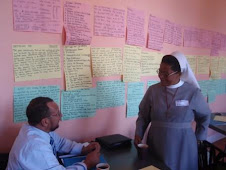
We have just started a 3-year programme to develop the leadership skills of the principals.  Most of them have had little formation beyond teacher training and yet might still be the most formally educated person in the village.  Because they are so isolated, we took out a road-show to 5 distant locations, some around the edge of South Africa (near Nambia, near Botswana, near Mozambique) and some dead in the flat arable centre of the Free State or the rolling hills of the Transkei. 

The course is not rocket science – setting a vision, reflecting and journaling, peer support, identifying the few things you can change rather than getting bogged down in the ones you cannot – but I suspect that the main value of the first workshop was that these principals felt that someone cared enough to come and visit and encourage them.  Whether that can produce material change we will see.  The blocks that they face were all the worse since they were elements of the system that was supposed to be supporting them – incompetent Government officials, frequent changes of curriculum, inflexible unions, obstinate parish priests, unskilled governors, unusable policies. 

But we did hear some good news stories: a young woman who had grown up on a farm school, had qualified as a teacher and then gone back as principal of the same school; a man who was recently struggling to pay for a family bucket at the local KFC until someone behind him in the queue offered to pay – the stranger who was now a successful doctor was someone he had taught 20 years earlier!

A quite different foray into the world of education has been a local counterblast to Dawkins.  We have been running workshops for school students to show them that they do not have to choose between evolution and creation: they are completely compatible answers to 2 different questions.  So it is possible that humans beings evolved from apes and yet are also ‘made in the image and likeness of God’.  Invoking the great Jesuit palaeontologist, Theilard de Chardin, we are not trying to explain how human beings became spiritual but instead can just delight in the mystery that spiritual beings became human. 

What is especially interesting is that this initiative was not ours but came from the Origins Centre at Wits University, one of the world’s leading fossil centres and where the recently discovered the 2 million year-old hominid, Sediba, is housed.  Not something you could imagine the Natural History Museums in London or New York doing!  But the scientists here thought this was a project worth investing in and needed some rational religious as their partners.  The sight of a roomful of school-kids asking a priest about the sexual urges of the evolutionary dead-end that is the zonkey made me realise that this is just what the Jesuit Institute is good at.  

Even without schools to run, we can bring to life the tradition of questioning and wondering that marks Jesuit education.  

Friday, 9 April 2010

The Medium and the Message

One thing that religions, and especially the Catholic Church, have tended to be good at in previous centuries is communication.  Whether through printing or music or art or architecture or just good stories, the Church has often been admired (or feared) for her ability to get her message across.  However, curiously, in the modern age – the age of communication! – this has been proven to be less and less the case.  At the very least this has seen the Church’s message become more irrelevant or just invisible to many people.  In the worst cases, as we have seen recently, it has shown the Church to be unable or unwilling to say what people need to hear in a language that they will accept. 

I am not going to offer any communications advice to Church authorities in the present crisis beyond recommending honesty and humility.  Instead this month I do want to share some of our own recent experiences of communicating some part of the Church’s message here in South Africa.

The main liberal secular paper here is called the ‘Mail & Guardian’.  A glance at its politics and its typography will show that it has much more in common with the British ‘Guardian’ than the ‘Daily Mail’.  Every Easter they have a special supplement known as the God Issue, since for at least this one weekend they run stories about faith which are not based around scandal (which after all is 1 weekend more than the papers in the UK!).  After last year’s God Issue we suggested, ever so gently, that they might benefit from the involvement of people who actually knew something about religion.  To our surprise they accepted our challenge and invited (Fr) Anthony Egan, one of the Jesuits on my team, on to the editorial board. 

Thus, the Jesuit Institute was able not only to contribute some very interesting articles (about Church engagement in politics or about ancestral spirits in the Philippines) but also shape the way in which faith could be presented in a reasonable way to a broadly non-believing rational readership.  I don’t imagine it converted anyone – and that was not our intention – but at least it meant that some South Africans might have paused over their hot cross buns and remembered that Easter for many people was still a religious festival.  (Talking of which, the South African commitment to shopping or to eating proves to be unimpeded by religious sensitivities.  I saw in one Northern Suburbs supermarket that they were selling ‘kosher hot cross buns’.  I guess they were the ones that had not risen.)

The Easter services themselves – effectively a 3-act participatory drama – are a great act of communication.  They do in part reach out beyond the usual church-goers since there are many hundreds more in church on Good Friday than on most Sundays (though they are only seeing the middle act of the play).  But even for the regulars these services are important since they remind us of what lies at the heart of our faith and that those events in Jerusalem 2000 years ago – the death of a man but also his resurrection – are still part of our lives today.  I had a great sense of that in the Good Friday afternoon service in Soweto where there were well over 2,000 people filing in devoted silence through the church to venerate the cross – old men and women who seemed to bear on their faces the wounds of the Struggle, and young children for whom the New South Africa was all they knew. 

But we at the Jesuit Institute have been reaching beyond the walls of the churches and also using the airwaves to get our message across.  The local Catholic radio station, Radio Veritas (“The Good News, for a change!”) had managed to obtain an FM license just for the period of Lent and so we offered to provide them with almost 30 hours of programming.  Driven by our own passions and enthusiasms we delivered a range of material: a magazine programme about current affairs, a phone-in about ways of praying, a series of interviews with people in different professions talking about how they found God in their secular workplaces, and a series in which we explored what religious sub-text there might be in contemporary culture (from ‘Harry Potter’ to ‘The Godfather’).  You may not be surprised to hear that I came into my own when talking about finding God in Broadway musicals (‘Oliver’ and ‘Les Mis’ were easy; ‘La Cage aux Folles’ a bit more challenging). 

One series of programmes was tied to a set of lectures that the Jesuit Institute has traditionally offered during Lent.  The subject that we took this year was how to find God in the face of suffering and our 4 lectures covered disasters, climate destruction, depression and death.  (It’s not all jollity, you know).  The honesty of the personal reflections had a huge impact not only on the people in the hall but on those listening at home, enhanced by the decision to illustrate each talk with extracts from a Requiem Mass (Britten, Verdi, Fauré and Mozart). 

The Church needs to use to good effect these sophisticated forms of communication.  And we can also cut through the technology and offer the opportunity for powerful communication in the simplest form possible – a conversation.  One of the links I made last year was with the Business School of Georgetown, the enormous, influential and very wealthy Jesuit university in Washington DC.  Members of their MBA class came over early in  March to present some consulting work they had been doing for South African organisations.  As part of that they met a lot of South African business people, and business students.  They even had the traditional tour of Soweto but that is about as useful a way of getting to understand South Africa as a drive through the East End is for getting to know England.  So we offered them a real encounter, or as they say in Zulu an ‘Indaba’. 

The 50 very impressive, very well-educated, very well-heeled American graduate students sat down with 30 no less impressive but much less educated and certainly more poorly heeled young people from the Jesuit parish in Soweto.  And apart from a few guiding questions we just left them to talk.  2 hours later both groups were reeling from the power of the encounter, of being able to have an honest conversation with someone who appeared at first to be so different and yet under the surface was so similar.  They shared their dreams, their fears and their business ideas.   And they even shared the true African experience of trying to have a conversation in a school hall while the deafening rain is pelting down on the tin roof.  Gratifyingly, many of the American students described this simple conversation as the highlight of their visit. 

Getting across a message of hope and possibility and new life can be done in the pulpit.  But we have also been trying to communicate through radio and press and lectures and simple conversations.  In fact almost any way that works apart from shouting at people. 

Tuesday, 23 February 2010

Doing God and doing politics

Desmond Tutu, the retired Anglican Archbishop of Cape Town, Nobel Prize winner, and high priest of national reconciliation, was once accused of making the Bible political.  He replied: “I don’t know which Bible you are reading but mine is already political!”

The claim of Tony Blair’s spin doctor that ‘we don’t do God’ would make little sense in South Africa.  Tutu was not the only hero of the struggle for whom faith was key to his motivation.  Albert Luthuli (the first South African Nobel Prize winner from 1960) was a lay preacher; Chris Hani who was led the militant wing of the ANC until he was brutally killed by Apartheid forces almost became a Catholic priest; and Mandela himself ‘does God’ throughout ‘The Long Walk to Freedom’. 

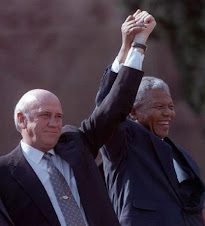
We have just been marking the 20th anniversary of one of the key moments in that Long Walk: the day that Mandela was released from prison, no longer a terrorist (sorry, Margaret Thatcher) but now a national leader.  Mandela’s release happened because, 9 days before, FW de Klerk, the last President of the party of Apartheid, had made the speech of his life.  In fact, the speech of the lives of most South Africans.  In just a few paragraphs delivered to an all-white Parliament, he announced the unbanning of the ANC, the dismantling of apartheid laws, the release of anti-Government prisoners and a commitment to a universal electoral franchise. 

Was it a miracle?  FW dismisses the idea that he had an overnight Damascene conversion.  But he does explain that he was impelled to make these changes not just driven by pragmatism but by a religious sense of what the right thing to do. 

Of course, the history of politicians ‘doing God’ is not a universally positive one.  The very institutional cruelty that FW dismantled in God’s name was created in God’s name by devout members of the Dutch Reformed Church.  George W (if not Tony) claimed God’s revelation for his invasion of Eye-raq.  And fundamentalist bombers from a variety of religions use God as their excuse as they pull the triggers or crash the planes. 

Faced with this, the common reaction in the ‘developed’ world is to dismiss any mixing of God and politics.  The syllogism runs thus: “Religion leads to violence.  Violence is to be avoided.  Religion is to be avoided.”    But hidden in that is a slide from ‘some religion leads to violence’ to ‘all religion leads to violence’ and even ‘religion only leads to violence’.  And even though some religion does lead to violence it is hardly the only thing that does. So do nationalism, and private property, and political parties, and armies.  And we don’t assume that we can just avoid those. 

The Dawkins disciples uniquely scapegoat religion and seek to remove it from the public space.  Constitutional clauses of separation of Church and State attempt to address this.  But the fact that religion remains embroiled in politics in the USA (where there has been such a clause for 230 years) but not in the UK (where there isn’t) suggests that such a top-down approach has little impact.  South Africa in many ways is like the US.  On paper a liberal secular constitution with a clear separation of Church and State; but at the same time a deeply religious society in which the majority of people are Church-goers (or Mosque-goers or Temple-goers) and in which God’s presence is routinely invoked in public discourse. 

To try and ignore God would, at the very least, be disrespectful of the millions of voters for whom God’s presence is key to their sense-making of themselves and of the world.  It is hardly democracy to tell people that they can vote freely but only once they have discarded one of their deepest beliefs.  But more than that, I believe that religion can be a force for good in the world and so needs to harnessed in the pursuit of good politics, no less than in the pursuit of good education, good business or good charity. 

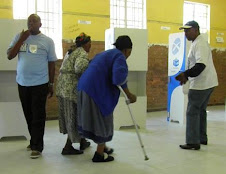
That is one of the reasons why the Jesuit Institute was set up.  Not to convert politicians to become believers – that hardly needs doing in SA – but to promote a presence of God in politics that reinforces the FW/ Tutu/ Luthuli legacy.  For example, last year during the elections we distributed 10,000 leaflets encouraging Catholics to think about how to apply their faith principles when in the voting booth. 

Thus, I found myself last Monday in the Cathedral offices in Cape Town directly opposite Parliament at a reception for ministers, MPs and Ambassadors (sadly without the Ferrero Rocher).  The reception was hosted by the Catholic Parliamentary Liaison Office – a lobby group like so many others – but one that seeks to draw on the Church’s experience especially in education and healthcare and use it to inform national debate and policy.  (Hopefully it also discourages certain Church leaders from holding forth on subjects where the Church has little expertise and fails to learn from experience.) 

We were launching a series of reflections for Lent.  Every day since Ash Wednesday, each of the country’s 420 MP’s has been receiving a daily e-mail from the Jesuit Institute.  It contains a quotation (from people as diverse as Isaiah, St Augustine, Gandhi or Wangari Maathai), a short commentary and a prayer.  Of course the MP’s can un-subscribe; but so far almost no one has.  And – given that politicians need as much help as they can get – we are inviting others to pray with and for our MP’s and so far 500 people have signed up.  (If you would like see an example of the reflections or even sign up click: www.jesuitinstitute.org.za/en/node/186#attachments)

If politicians are going to ‘do God’ – and it would be hard to stop them – I believe they need to be informed and challenged.  Our reflections are not vague platitudes but, in the Ignatian tradition, prompt MPs to reflect on their actions and see where they are building the Kingdom, and where they are not.  We hope to prompt our politicians to ‘do God’ in a constructive way; and we also hope to model how our God-people can do politics in a good way.  To quote Tutu again: “Religion is like a knife: you can either use it to cut bread, or stick it in someone's back.”

Tuesday, 26 January 2010

Fitting in

Two weeks in to the great African adventure and a chance to reflect on what has happened so far.  A fellow novice once commented that I had the great ability to feel at home wherever I was – whether living in designer apartments in London or New York, or in the shadow of a Victorian church in Tottenham, or in a refugee camp.  And the same seems to be true once more.  I have slipped into life in Jo’burg with minimum angst.  My philosophy is to accept how a situation is (and perhaps work to change some aspects) rather than spending time worrying how it might have been otherwise. 

All of the necessary bits seem to be in place.  I have a house – immensely comfortable and spacious and full of light and air.  I have friends – not quite as many as in London but enough that I have only spent 3 evenings on my own since I got here.  I have colleagues whom I think I am going to like – though I am not sure they yet know what to make of me.  And I have a job which is certainly going to absorb me – more on that next time. 

I also now have a phone.  I know that seems trivial but, since all mobile contracts here are for a minimum of 24 months, choosing a phone could have more enduring significance than choosing a lover.  The problem is that not only are all the schemes more expensive than in the UK but they seem endlessly complicated.  However, the King of Brand Valuation is not to be daunted by a spreadsheet challenge.  So I put together an analysis that took into account fixed vs variable charges, billing by minute vs billing by second, calls within network vs calls outside, voice vs texts vs data, decreasing charges after the first minute or after the first 5 minutes, peak vs off peak vs happy hours and calls to blacks vs whites vs coloureds.  (OK, perhaps that was a pre-94 calling package). 

You probably don’t care but I ended up with a Virgin Bundle (why does that sound rude?) and a Nokia Navigator that doubles as a GPS.  Given the huge scale of the conurbation (the map book has 429 A4 pages), and my propensity to keep driving even when I don’t know where I am going,  having the voice of ‘Ellen’ gently advising me to do a U-turn is a great asset.  If only there were a GPS for life.  Or is that what religion is….?

The other problem to solve is a car.  The area is vast and the public transport system very poor.  Of course, they promise that it is all going to be so much better – but not yet.  A high speed rail link is in process; but it won’t be finished until 2 years after the World Cup (any Londoners feeling smug should just remember the words ‘Cross Rail’).  And a dedicated bus lane system (trams without tracks) is emerging across town.  But slowly. 

Until then, the main means of public transport is what are called taxis here, are known as ‘mutatu’s’ in East Africa, and you and I might recognise as a mini-bus.  There are thousands of them, they drive along with 12 passengers not as a maximum but as a minimum, and people just seem to know by telepathy which one to get.  A mark of how dangerous they are is that I heard of one where the driver was steering using a monkey wrench since, having removed the steering wheel, he had more space to squeeze in an extra passenger.  They are incredibly badly driven, keep stopping in the middle lane for people to get out, swerve unexpectedly, and indicate one way while they go in the other.  In fact, they behave just like cyclists in London. 

And cycling here is definitely not an option.  Though it would be an easy 4 mile ride to work, it would be madness because drivers here have absolutely no experience of sharing the road with a bike.  In fact, though cycling in the parks is a great hobby, I have only seen one cyclist actually on a road.  So a car is essential.  For the moment, the Jesuits have lent one me from their car pool.  Curiously it has the letters XJ in the number plate.  Is this the one that is especially reserved for ex-Jesuits?  In fact, now I look again it is XXJ – so I guess this is the one for fat former Jesuits. 

This weekend’s project therefore is to go car-hunting.  Spreadsheets might not save me this time but a friend of a friend of a friend who is a mechanic is willing to come along and ask some of the difficult questions.  When I walk into a second-hand dealer and say ‘Don’t you have it in cerise?’ they know immediately that I am not in my zone. 

Cars are one of the many things that are more expensive in SA than in the UK. And that is certainly not because they are all imported.  Thanks to the apartheid years, SA has a well-developed domestic car assembly industry with Toyota, Ford, VW and even BMW having local plants.  You would have thought that would keep prices down, especially when the factories benefit from the cheapest electricity in the world.  Nor is there any shortage of retail competition: the main roads radiating out from central Jo’burg contain mile after mile of second-hand car dealerships to rival any mid-Western American strip malls.  But for reasons that I have not yet understood, cars are still more expensive.  A three-year-old VW Polo for example would cost about £9,000. 

Not only are cars expensive but insuring them is also expensive.  That is partly because SA has a very high rate of accidents – some people (no matter what their colour) drive as if everyone else was an inconvenient fly to be swatted away. But there is also a very high rate of car theft.  And, for people with very nice cars, car-jacking.  So, despite the attractions of the sunny clime, this is not the moment to splash out on a convertible Mercedes, even if I had the money.  I suppose I could tell myself that it is a commitment to living sustainably! 

Actually, I have to confess that the famously sunny South Africa has rather let me down so far.  If you were watching the cricket you would have seen how much rain we have been having (though sadly not enough to save the visitors).  In fact, the afternoon when Russell and I spent 4 and a half hours at the Wanderers to watch the 4th Test, we saw only 4 overs.  (For American readers that would be the equivalent to the ball being pitched a mere 24 times).  To be fair I wasn’t really there to watch England’s bowlers and batters so much as to watch England’s barmy army of supporters.  And they did not fail to entertain.  There may have been little play but there was plenty of beer, and puddles to splash in, and girls in wet T-shirts.  Needless to say I kept my silence, refrained from waving a flag of St George, and tried to blend in with the South Africans.  Which is not hard at a cricket match since there were at least as many brown-skinned SA supporters as white ones (while very few black-skinned ones). 

Thunderstorms aside, life here so far has been most pleasant even if it still feels like an extended business trip.  And just in case you thought that I wasn’t really here you can tune in and hear my first bit of publicity.  It is on a local Catholic radio station and so if a dozen of you listen on the internet you will probably double the audience.  So if you are idle for an hour at 4pm GMT on Sunday 24th click on www.radioveritas.co.za and you can hear me being beamed out of Africa.  

Friday, 25 December 2009

Next year in Johannesburg

Just as you are enjoying the nice cosy bit of the Christmas story, don’t forget that the next instalment has Jesus fleeing with his parents to start his new life on a new continent. In an age where most people seem to be travelling ‘out of Africa’, I shall soon be following Jesus, Mary, Joseph and the donkey - by moving in to Africa.


So that is why, after a two-and-a-half year silence, you are receiving a newsletter from me, though now elevated to the blogosphere. My desire to write again has been inspired by the big skies of Africa. However, the inspiration is not only proximity to the Equator but also proximity to the Jesuits. If you have not heard on the grapevine, let me explain.


As of January 2010 I shall be moving to Johannesburg to take up the position of Director of the ‘Jesuit Institute of South Africa’. 2 acronyms that have been associated with me – SJ and SA – making a re-appearance from earlier chapters, but now starring together for the first time. But though I shall be working with and for the Jesuits, I shall not be doing so as a Jesuit. The Society of Jesus used to have a description of themselves as ‘in the world but not of it’. I guess I am going to be with the Society but not in it!


But that is not unusual. A glance at any of the Jesuit schools or universities or the refugee service will show that most of the people employed in Jesuit works (and even running them) are not Jesuits but lay men and women. They don’t take vows of poverty, chastity or obedience and yet are still committed to ‘faith that does justice’. In fact, the Jesuit Institute of South Africa – please don’t call it JISA! – is already an organisation that is half J and half lay. We are not a large group, 4 Jesuits (vowed celibate men) and 4 non-Jesuits (married and single women). I guess I sit somewhere in the middle of that spectrum!


The Institute was set up 3 years ago and brought together a number of people and activities that were already connected with the Jesuits in South Africa. But it is still hard to say succinctly what it is for; that process of clarification is part of what I am helping to lead. The general premise is that it is a ‘centre for dialogue’ – engagement between the Church and Society, the Church and the media, the Church and academia, the Church and people’s day-to-day lives, even the Church and the World Cup! One particular area that we are interested in exploring is the Church and business – and that is one additional reason why I have been brought in. http://www.jesuitinstitute.org.za/


If I find it hard to capture in a few words what the Institute is about that is because the talented team already do so much. In fact, I spent some time working with the team in October to try and find some pattern to what we do. After filling out 150 pieces of different coloured cards with descriptions of our activities and sorting them in a variety of ways the clearest conclusion that we could come to is that we are probably not very clear. But that in itself is useful.


At a previous planning exercise, we at least got to one of those sets of words beloved by consultants and variously called a Mission Statement, a Vision, a Strategic Intent, a strap line or a positioning. (Even when I did that sort of thing for a living I could never tell the difference between them). Ours is: ‘Enlarging the Horizons of Hope’. Of course there was the inevitable scholastic debate between those who wanted to enlarge the horizons, those who wanted to expand them and those Anglo-Saxons who were happy just to broaden.


I am still not entirely sure what we do with that phrase but it at least provided an opportunity to ask: whose horizons? So we did another card sorting exercise and we managed to identify at least 12 distinct audiences whose horizons the team wanted to prioritise – which with only 8 full-time-equivalent staff suggests that we may need to enlarge/ expand/ broaden ourselves before we try to take on all those horizons. And that’s even before beginning the new challenge of working with the business community.


But that is part of the reason for doing this. It’s a big new challenge and, which is especially tempting for me, something that I can be in charge of and can shape. I may have a lot less resource than I have in my current role in CAFOD but at least they are my resources.  And the focus will be on problem-solving and not just process-following.  The thrill of running a small business – that I first witnessed in the early days of Interbrand, and then experienced for myself when at Rhino Camp – is that you sink or swim by your own efforts. There is no one else to blame. There aren’t too many others to get in the way. Decisions can be made without having to get 23 people in a room or send out an email and wait for replies that never come.


Working in Jo’burg will certainly be a challenge. I don’t yet have a notion of how much living there may also be a challenge. At least I have found somewhere to live. In fact within a few hours of arriving on reconnaissance in April, I met a delightful couple, saw their lovely 2-bedroom house and discovered that they wanted to rent it out. It is in an area called Melville, described as the Islington of Johannesburg which certainly works for me. It is only 3 miles from the office – 5 minutes to drive at night and 40 minutes during the rush hour. However, having seen the local drivers I am afraid that I shall not be continuing my London modus ambulandi of cycling. Johannesburg is dangerous enough without adding to the excitement.